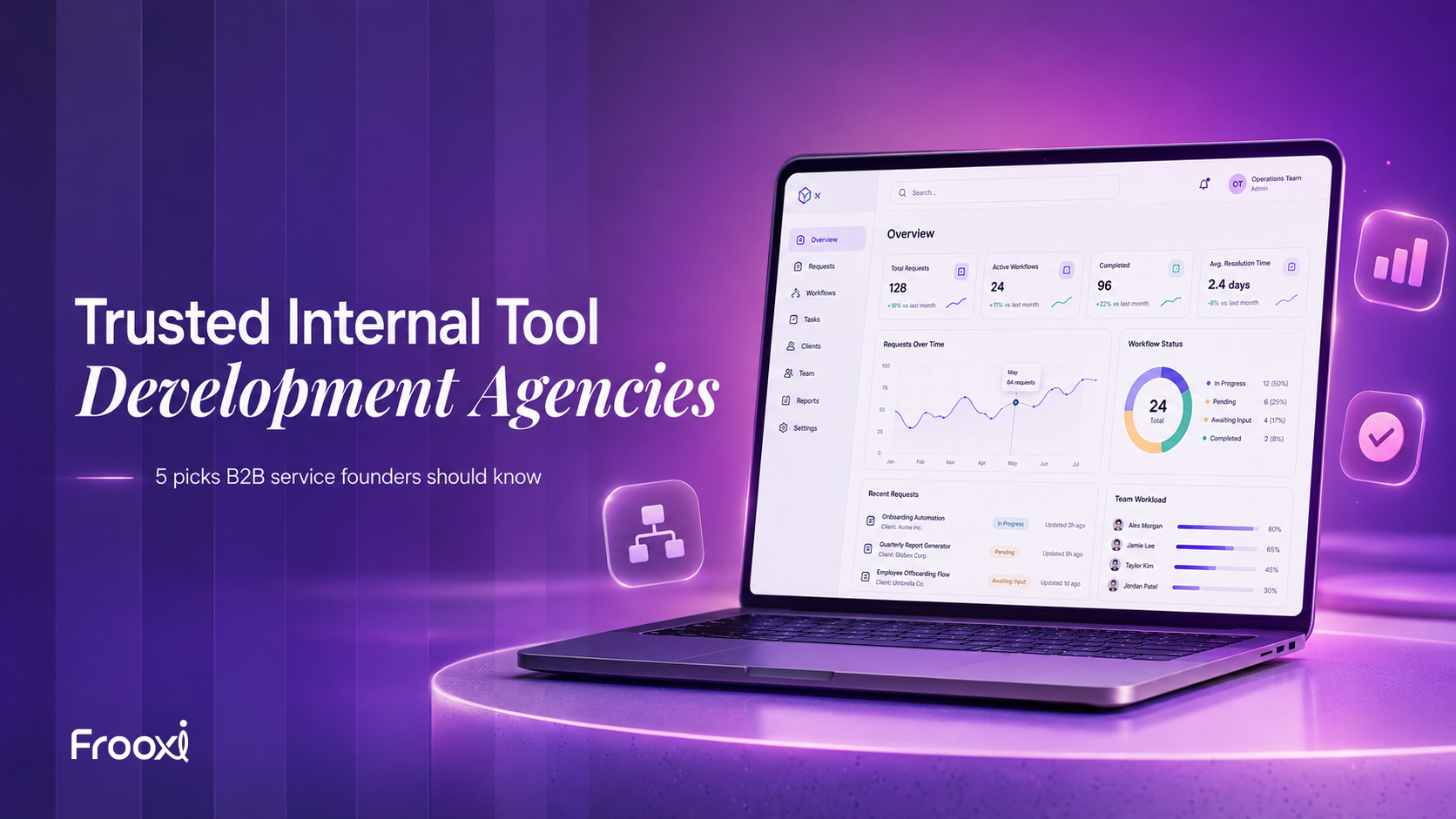
Search “internal tool development agency” and you’ll find plenty of teams promising custom dashboards, CRMs, portals, and automation. The harder part is finding one that understands the workflow underneath the software. For B2B service companies, that matters. Leads, client data, delivery, reporting, and approvals often sit across several tools already. A custom system should reduce that complexity, not become another place your team has to check. In Frooxi, we treat them as a core focus rather than a side project.
5 Internal Tool Development Agencies B2B Service Founders Should Know
Here are five internal tool development agencies worth knowing, each suited to a slightly different type of project.
LOW/CODE Agency
LOW/CODE Agency builds internal apps across low-code and custom technologies rather than forcing every project onto one platform. Its portfolio spans internal tools, SaaS products, mobile apps, AI systems, and business software. The company says it has shipped 400+ products with a 40+ person global team. Internal business apps currently start around $15,000. Best For: Companies that need help choosing between low-code, automation, AI, and custom development. Price: Internal apps from around $15,000.
Airdev
Airdev focuses heavily on custom business software and internal systems that replace spreadsheets or rigid off-the-shelf tools. Its internal-tool work covers admin panels, dashboards, approvals, reporting, permissions, and integrations with existing systems. Airdev says it has shipped 1,000+ products, including internal platforms for organizations such as Teach For America and Cadence Translate. Best For: Companies that need a larger operational platform rather than a simple dashboard. Price: Projects start around $10,000 for its agency offering.
Retoolers
Retoolers is the specialist option on this list. The team focuses on Retool and commonly builds CRMs, admin panels, approval systems, client portals, reporting tools, ERP-style systems, and operational dashboards. Its pricing is also unusually transparent: hourly work starts at $30 with a 30-hour minimum, while retainers begin at $1,800 per month. That makes it worth considering when your data already exists and the main problem is giving your team a better interface to work with it. Best For: Retool dashboards, operations tools, portals, and admin systems. Price: $30/hour or retainers from $1,800/month.
Online Tooling
Online Tooling takes an ongoing-team approach rather than treating every internal tool as a one-time project. Everything is built around Retool, with plans covering maintenance, new application development, training, roadmap ownership, and product management. Its published subscriptions range from $2,500 per month for maintenance to $20,000 per month for an embedded tools partnership. That model makes more sense for businesses whose operations change constantly and need their internal systems to evolve with them. Best For: Companies that want an ongoing Retool development partner. Price: From $2,500/month.
Frooxi
Frooxi approaches internal tools from the business workflow first. We work primarily with founder-led businesses where the problem is often not one broken application, but several disconnected processes. For Mateluxy, a Dubai brokerage, what started as a website eventually became a broader ecosystem that included its CRM, agent application, property-management system, community platform, and website. Across Frooxi, our small team has shipped 8+ systems for clients across Dubai and the United States. We also do not assume custom software is always the answer. If an existing SaaS product fits the workflow well, it usually makes more sense to use it. Best For: Growing B2B service companies whose websites, client workflows, internal operations, or automation need to work as one system. Price: Based on scope. Disclosure: I’m the Co-Founder of Frooxi, so Frooxi is included here because this is the market we work in. This list is not ranked from best to worst.
Why Internal Tools Are Different
Internal software does not win because it looks impressive. It wins because employees stop needing workarounds. A good internal tool should usually solve problems such as: Repeated data entry: The same information should not need to move manually between three systems. Disconnected workflows: Sales, delivery, finance, and client operations should not depend on someone remembering what happens next. Poor visibility: Teams should be able to find the information they need without asking the one person who understands the entire process. Software mismatch: Your workflow should not become unnecessarily complicated just because an off-the-shelf tool was designed for a different business. That is why the first conversation with an internal-tool agency should not be about frameworks. It should be about how your business actually works.
End Note
Another SaaS subscription is often cheaper and faster than custom software. If it solves the problem, buy it. But once your team spends more time working around its tools than working through them, a custom internal system becomes worth considering. The right partner is not simply the one that can build it. It is the one that knows what should not be built in the first place.